
Dried Hibiscus FAQ for Importers
Answers to the questions importers ask us before requesting a quote.
What exactly is dried hibiscus, and which part of the plant do you export?
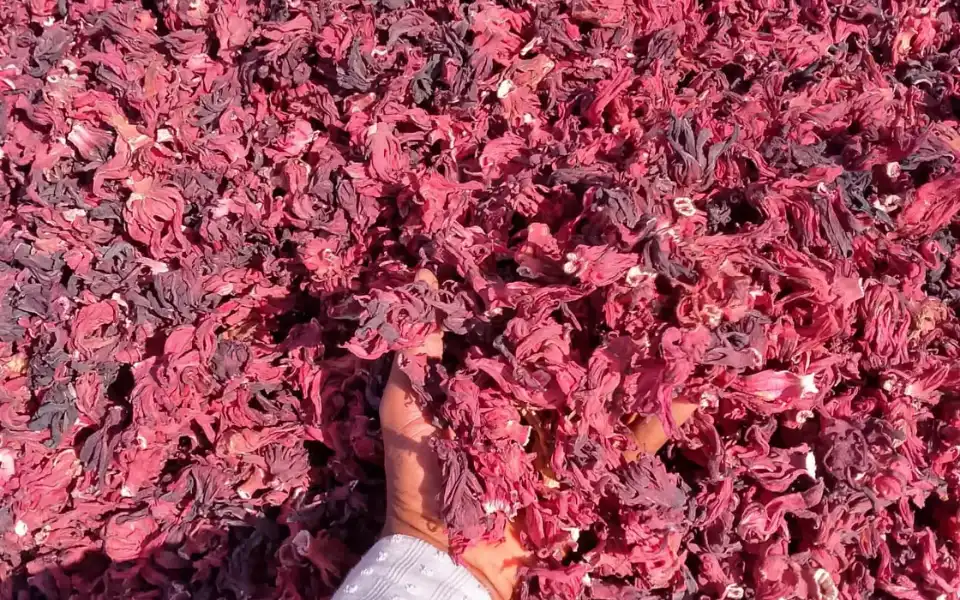
Dried hibiscus is the calyx of Hibiscus sabdariffa L., also called roselle: the fleshy, deep red sepals that surround the seed pod. It is not the petal or the leaf. We export the whole dried calyces (dried hibiscus flowers), sourced and processed in Nigeria.
Are zobo, karkade, flor de Jamaica, bissap and sorrel the same product?
Yes. They are local names for the same dried calyx of Hibiscus sabdariffa. It is called zobo in Nigeria, bissap in Senegal and West Africa, karkade in Egypt and Sudan, flor de Jamaica in Mexico and Central America, and sorrel in the Caribbean. In international trade it is usually listed as dried hibiscus flowers or roselle.
Is your hibiscus whole or cut?
We supply whole dried hibiscus flowers: about 95% of the product is whole calyces. Whole calyces keep their colour and natural compounds better, which is why tea, beverage and food manufacturers prefer them for infusions, blends and their own cutting or extraction.
What is the moisture content of your dried hibiscus?
Below 10%. Low moisture protects the colour and flavour of the calyx during storage and international transport, and reduces the risk of mould.
What colour and flavour does Nigerian hibiscus have?
Nigerian hibiscus has a deep red colour and a natural tart flavour. It is rich in anthocyanins, the pigments that give the red colour, and in organic acids. Nigeria is one of the world's leading producers of hibiscus.
Which crop are you selling?
The 2026 crop from Nigeria.
What is dried hibiscus used for?
Herbal tea and infusions, cold and hot beverages (such as agua de Jamaica, zobo or bissap), jams, syrups and sauces, natural red colourants and flavouring, nutraceutical and health products, and bulk industrial processing such as cutting, sifting and extraction.
How do you select and process the hibiscus?
The calyces are harvested at full maturity, dried under controlled conditions, sorted manually and mechanically to remove foreign matter, inspected against export grade and the buyer's specification, and packed in 25 kg export bags.
How pure is the product?
The hibiscus is free of weeds, stones and any other foreign matter. Each lot is sorted and inspected before packing.
How is dried hibiscus packed for export?
In 25 kg polypropylene (PP) bags: net weight 25 kg, gross weight 25.15 kg, bag size 75 × 125 cm.
What does neutral packing mean?
The bags are plain, with no labels or printing. The importer can resell, relabel or repack the product under its own brand.
How should dried hibiscus be stored?
In a cool, dry place, away from direct light and humidity, in closed bags kept off damp floors. Opened bags should be resealed. Dry storage keeps the colour and flavour of the calyces.
Do you publish prices for dried hibiscus?
No. The price depends on quantity, destination port and Incoterm, and on the market situation at the time of the order. Send us those details and we will quote.
What information do you need to send a quote?
Your company and country, the quantity in tonnes or containers, the destination port, your preferred Incoterm, and any specification or document your market requires.
Which export documents can you provide?
Export documents are shared on request, according to the requirements of your destination market. Tell us your country when you ask for a quote.
What HS code is used for dried hibiscus flowers?
Dried hibiscus calyces are commonly declared under HS 1211.90. The exact national tariff code varies by country (Mexico, for example, uses 1211.90.99), so confirm it with your customs broker.
Who do you supply?
Importers, distributors and manufacturers that buy dried hibiscus in bulk, packed in 25 kg bags for international shipment.
Who is the seller?
CHE International Brokers LLC, a U.S. company based in Doral, Florida (3625 NW 82nd Ave, Ste 100K, Doral, FL 33166, USA), with operations in Nigeria.
Why buy Nigerian hibiscus through a U.S. company?
Sourcing from Nigeria can raise questions about reliability, communication and the security of the transaction. We combine on-the-ground operations in Nigeria with a U.S.-based business structure, which gives importers more transparency and accountability in every deal.
Who will I be talking to?
Facundo Damil, CEO of CHE International. You can write to fdamil@cheinternational.com or contact him by phone or WhatsApp at +34 614 31 36 47.
Which languages do you work in?
English and Spanish.
Ready to source dried hibiscus from Nigeria?
Prices and documents on request. Tell us the quantity, destination port and Incoterm.